UCAT — University Clinical Aptitude Test (UK medicine)
UCAT Quantitative Reasoning, Set 1
Take the UCAT Quantitative Reasoning, Set 1: 20 multiple-choice questions (30 minutes) with instant scoring and a full answer review. Covers 20 UCAT…
What this test covers
- 20 UCAT Quantitative Reasoning
Sample questions with answers
The first 5 questions of this test, with the correct answer and explanation.
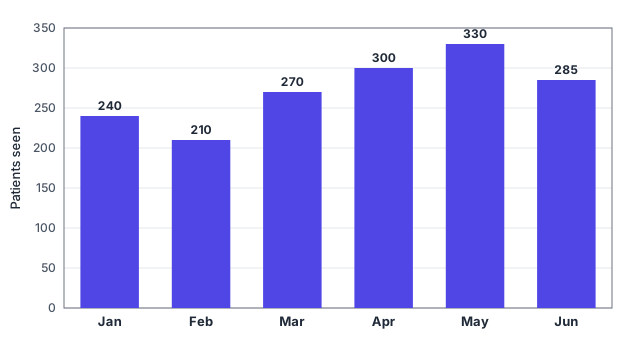
Q1. The bar chart shows patients seen at a clinic each month. How many patients were seen from January to June in total?
- A. 1635 ✓
- B. 1600
- C. 1735
- D. 1535
Answer: A. 1635
Explanation: 240 + 210 + 270 + 300 + 330 + 285 = 1635.
Q2. Using the chart, what was the percentage increase in patients from January to May?
- A. 37.5% ✓
- B. 90%
- C. 27.3%
- D. 33.3%
Answer: A. 37.5%
Explanation: (330 − 240)/240 = 0.375 = 37.5%.
Q3. Using the chart, what was the mean number of patients per month?
- A. 285
- B. 300
- C. 272.5 ✓
- D. 270
Answer: C. 272.5
Explanation: 1635 ÷ 6 = 272.5.
Q4. Using the chart, in which month was the increase from the previous month the largest?
- A. May
- B. April
- C. June
- D. March ✓
Answer: D. March
Explanation: March: +60; April: +30; May: +30; June: −45.
Q5. If the clinic sees 20% more patients in July than in June, how many patients will it see in July?
- A. 305
- B. 340
- C. 350
- D. 342 ✓
Answer: D. 342
Explanation: 285 × 1.2 = 342.
The other 15 questions
Take the timed test (free, no sign-up) to see your score and the answer and explanation for every question.
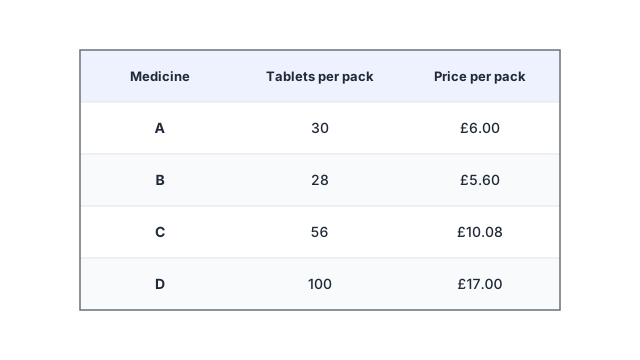
Q6. The table shows four medicines. Which has the lowest price per tablet?
- A. C
- B. B
- C. D
- D. A
Q7. A patient needs 112 tablets of medicine C. How much will this cost?
- A. £18.00
- B. £20.16
- C. £10.08
- D. £22.40
Q8. By what percentage is medicine D cheaper per tablet than medicine A?
- A. 3%
- B. 20%
- C. 15%
- D. 17%
Q9. Medicine B is offered at 20% off. What is the new price per tablet?
- A. £0.18
- B. £0.20
- C. £0.14
- D. £0.16
Q10. How much more does one pack of D cost than one pack of C?
- A. £6.08
- B. £6.92
- C. £7.08
- D. £5.92
Q11. A drip delivers 125 ml of fluid per hour. How long will it take to deliver 1 litre?
- A. 6 hours
- B. 12.5 hours
- C. 8 hours
- D. 10 hours
Q12. A dose of 5 mg per kg of body weight is prescribed. How much should a 64 kg patient receive?
- A. 64 mg
- B. 128 mg
- C. 320 mg
- D. 300 mg
Q13. A ward has 40 beds and 85% are occupied. How many beds are free?
- A. 34
- B. 8
- C. 5
- D. 6
Q14. A patient walks 3.2 km. How far is this in metres?
- A. 320 m
- B. 32 000 m
- C. 32 m
- D. 3200 m
Q15. An ambulance travels 18 km in 15 minutes. What is its average speed in km/h?
- A. 90 km/h
- B. 72 km/h
- C. 27 km/h
- D. 60 km/h
Q16. A solution is mixed in the ratio 1 part concentrate to 4 parts water. How much concentrate is in 750 ml of solution?
- A. 600 ml
- B. 150 ml
- C. 200 ml
- D. 187.5 ml
Q17. A clinic's budget rose by 10% one year and fell by 10% the next. Compared with the start, the budget is now:
- A. 10% lower
- B. 1% lower
- C. 1% higher
- D. The same
Q18. A shift starts at 19:45 and lasts 9 hours 30 minutes. When does it end?
- A. 05:15
- B. 04:15
- C. 05:45
- D. 06:15
Q19. Three doctors see a mean of 24 patients a day. A fourth doctor joins and the mean becomes 25. How many patients does the fourth doctor see?
- A. 28
- B. 25
- C. 30
- D. 26
Q20. A textbook costs $45. If £1 = $1.25, how much is the book in pounds?
- A. £36
- B. £56.25
- C. £40
- D. £35