UCAT — University Clinical Aptitude Test (UK medicine)
UCAT Decision Making, Set 2
Take the UCAT Decision Making, Set 2: 20 multiple-choice questions (30 minutes) with instant scoring and a full answer review. Covers 20 UCAT Decision…
What this test covers
- 20 UCAT Decision Making
Sample questions with answers
The first 5 questions of this test, with the correct answer and explanation.
Q1. All pharmacists in the town are registered. Ayesha is a pharmacist in the town. Which conclusion follows?
- A. Ayesha works in a hospital
- B. Ayesha is registered ✓
- C. Ayesha is a doctor
- D. Everyone registered is a pharmacist
Answer: B. Ayesha is registered
Explanation: Ayesha belongs to a group that is entirely registered.
Q2. No vegetables in the shop are frozen. Some items in the shop are carrots, and all carrots in the shop are vegetables. Which conclusion follows?
- A. No carrots in the shop are frozen ✓
- B. Some carrots in the shop are frozen
- C. Some vegetables are frozen
- D. All frozen items are carrots
Answer: A. No carrots in the shop are frozen
Explanation: All the shop's carrots are vegetables, and none of the shop's vegetables are frozen.
Q3. Some runners are swimmers. Some swimmers are cyclists. Which conclusion must be true?
- A. No runners are cyclists
- B. Some runners are cyclists
- C. All cyclists are runners
- D. None of these conclusions is certain ✓
Answer: D. None of these conclusions is certain
Explanation: The runners who swim and the swimmers who cycle may be different people, so nothing about runners and cyclists follows.
Q4. Every student who passed the exam attended the revision class. Bilal did not attend the revision class. Which conclusion follows?
- A. Bilal passed the exam
- B. Everyone who attended passed
- C. Bilal did not pass the exam ✓
- D. Bilal will attend next time
Answer: C. Bilal did not pass the exam
Explanation: Passing required attendance; Bilal did not attend, so he cannot have passed.
Q5. The Venn diagram shows what 40 people drink. How many people drink tea?
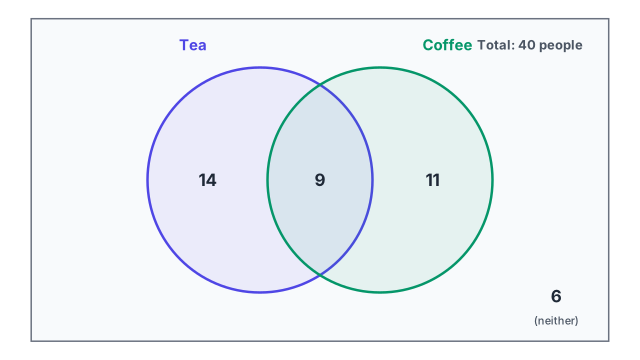
- A. 14
- B. 20
- C. 23 ✓
- D. 9
Answer: C. 23
Explanation: Tea only (14) + both (9) = 23.
The other 15 questions
Take the timed test (free, no sign-up) to see your score and the answer and explanation for every question.
Q6. Using the Venn diagram, how many people drink exactly one of the two drinks?
- A. 34
- B. 25
- C. 23
- D. 20
Q7. Using the Venn diagram, a person is chosen at random. What is the probability that they drink coffee?
- A. 0.275
- B. 0.5
- C. 0.575
- D. 0.225
Q8. Using the Venn diagram, a coffee drinker is chosen at random. What is the probability that they also drink tea?
- A. 0.45
- B. 0.225
- C. 0.39
- D. 0.55
Q9. Three doctors, X, Y and Z, are on call on Monday, Tuesday and Wednesday, one per day. X is not on call on Monday. Z is on call the day after Y. Who is on call on Monday?
- A. It cannot be determined
- B. Y
- C. X
- D. Z
Q10. Four friends each have a different favourite colour: red, blue, green or yellow. Sana's is not red or blue. Omar's is green. Hira's is not red. What is Ali's favourite colour?
- A. Blue
- B. Yellow
- C. Green
- D. Red
Q11. A meeting must be held on a weekday. It cannot be on Monday or Friday, and it must be after Tuesday. Which days are possible?
- A. Tuesday or Wednesday
- B. Thursday only
- C. Wednesday or Thursday
- D. Wednesday only
Q12. A fair coin is tossed three times. What is the probability of exactly two heads?
- A. 1/8
- B. 1/2
- C. 3/8
- D. 1/4
Q13. A box has 4 green and 6 white balls. Two are drawn without replacement. What is the probability that they are different colours?
- A. 1/2
- B. 12/25
- C. 2/5
- D. 8/15
Q14. The chance of rain on Saturday is 30%. What is the chance that it does not rain?
- A. 100%
- B. 70%
- C. 30%
- D. 60%
Q15. A school claims: "Our pass rate rose after we introduced tablets in class, so tablets improve learning." Which assumption does this depend on?
- A. Pass rates fall every year
- B. Students enjoy using tablets
- C. Tablets are expensive
- D. Nothing else that could explain the rise changed at the same time
Q16. Should hospitals provide free parking for patients? Which is the strongest argument for YES?
- A. Yes: car parks look nicer when full
- B. Yes: most people own cars
- C. Yes: parking is free in some countries
- D. Yes: parking charges can be a burden for patients who must attend often, such as those having regular treatment
Q17. Should all medical students learn a second language? Which is the strongest argument for NO?
- A. No: the curriculum is already full, and interpreters can be used when needed
- B. No: languages are boring
- C. No: English is spoken everywhere
- D. No: some students are bad at languages
Q18. A clinic reports that waiting times fell from 40 to 30 minutes after it hired a second receptionist. Which conclusion is best supported?
- A. The new receptionist may have helped reduce waiting times
- B. All clinics should hire three receptionists
- C. Waiting times will fall to 20 minutes next year
- D. The first receptionist was slow
Q19. If a patient has a fever, the nurse records their temperature every hour. The nurse is not recording a patient's temperature every hour. Which conclusion follows?
- A. The patient does not have a fever
- B. The nurse is busy
- C. The patient has a fever
- D. The patient will soon have a fever
Q20. In a group of 30 students, 18 study French and 15 study Spanish. Every student studies at least one of the two. How many study both?
- A. 0
- B. 33
- C. 3
- D. 15