O Level & A Level Mathematics (Cambridge)
O Level Mathematics — Algebra and Graphs, Set 1
Take the O Level Mathematics — Algebra and Graphs, Set 1: 20 multiple-choice questions (30 minutes) with instant scoring and a full answer review. Covers…
What this test covers
- 20 O Level Mathematics
Sample questions with answers
The first 5 questions of this test, with the correct answer and explanation.
Q1. Simplify 3(2x − 4) − 2(x − 5).
- A. 4x − 22
- B. 8x − 2
- C. 4x − 2 ✓
- D. 4x + 2
Answer: C. 4x − 2
Explanation: 6x − 12 − 2x + 10 = 4x − 2.
Q2. Factorise completely 6x² − 9x.
- A. x(6x − 9)
- B. 3x(2x − 9)
- C. 3(2x² − 3x)
- D. 3x(2x − 3) ✓
Answer: D. 3x(2x − 3)
Explanation: The highest common factor of the terms is 3x.
Q3. Solve 2x² − 7x + 3 = 0.
- A. x = 1/2 or x = 3 ✓
- B. x = 1 or x = 3/2
- C. x = 3/2 or x = 1/3
- D. x = −1/2 or x = −3
Answer: A. x = 1/2 or x = 3
Explanation: 2x² − 7x + 3 = (2x − 1)(x − 3).
Q4. Make r the subject of A = πr² (r > 0).
- A. r = A/π²
- B. r = A/(2π)
- C. r = √(A/π) ✓
- D. r = √A/π
Answer: C. r = √(A/π)
Explanation: Divide by π, then take the square root.
Q5. Solve the simultaneous equations 3x + 2y = 12 and x − y = −1.
- A. x = 2, y = 3 ✓
- B. x = 1, y = 4.5
- C. x = 3, y = 2
- D. x = 4, y = 0
Answer: A. x = 2, y = 3
Explanation: x = y − 1, so 3(y − 1) + 2y = 12, giving y = 3 and x = 2.
The other 15 questions
Take the timed test (free, no sign-up) to see your score and the answer and explanation for every question.
Q6. What is the gradient of the line joining (−1, 4) and (3, −4)?
- A. 2
- B. 0
- C. −1/2
- D. −2
Q7. Find the equation of the line with gradient 3 that passes through (1, 5).
- A. y = 3x + 2
- B. y = 3x − 2
- C. y = x + 4
- D. y = 3x + 5
Q8. The figure shows a straight line through (0, −1) and (2, 3). What is its equation?
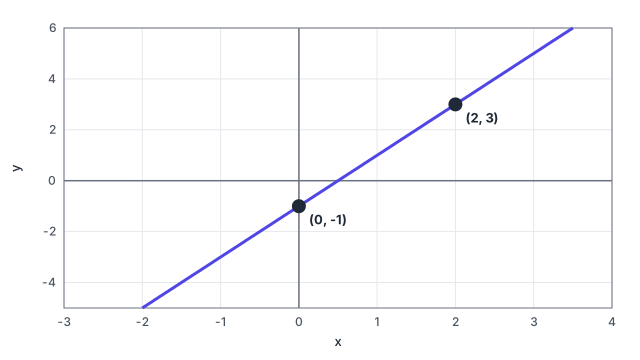
- A. y = −2x − 1
- B. y = 2x + 1
- C. y = 2x − 1
- D. y = x − 1
Q9. What is the largest integer x that satisfies 3x − 5 ≤ 7?
- A. 4
- B. 5
- C. 12
- D. 3
Q10. Find the nth term of the sequence 5, 8, 11, 14, …
- A. 3n + 5
- B. 5n + 3
- C. n + 3
- D. 3n + 2
Q11. Using the nth term 3n + 2, what is the 50th term of 5, 8, 11, 14, …?
- A. 155
- B. 152
- C. 170
- D. 150
Q12. y varies directly as x², and y = 12 when x = 2. Find y when x = 5.
- A. 30
- B. 300
- C. 60
- D. 75
Q13. y is inversely proportional to x, and y = 6 when x = 4. Find y when x = 8.
- A. 48
- B. 3
- C. 2
- D. 12
Q14. Expand (x + 5)(x − 2).
- A. x² − 3x − 10
- B. x² − 10
- C. x² + 3x − 10
- D. x² + 3x + 10
Q15. Simplify (x² − 9)/(x + 3).
- A. x − 9
- B. x² − 3
- C. x − 3
- D. x + 3
Q16. If f(x) = 2x + 3, what is the inverse function f⁻¹(x)?
- A. 2x − 3
- B. (x − 3)/2
- C. 1/(2x + 3)
- D. (x + 3)/2
Q17. f(x) = x² and g(x) = x + 1. Find fg(2).
- A. 4
- B. 6
- C. 5
- D. 9
Q18. Write x² + 6x + 2 in the form (x + a)² + b.
- A. (x + 3)² − 11
- B. (x + 3)² − 7
- C. (x + 6)² − 34
- D. (x + 3)² + 2
Q19. What are the coordinates of the turning point of y = (x + 3)² − 7?
- A. (−3, −7)
- B. (3, 7)
- C. (3, −7)
- D. (−3, 7)
Q20. Simplify (2x³)².
- A. 2x⁶
- B. 4x⁶
- C. 2x⁹
- D. 4x⁵