O Level & A Level Mathematics (Cambridge)
A Level Maths (Pure 1) — Quadratics, Functions and Coordinate Geometry, Set 1
Take the A Level Maths (Pure 1) — Quadratics, Functions and Coordinate Geometry, Set 1: 20 multiple-choice questions (30 minutes) with instant scoring and…
What this test covers
- 20 A Level Pure Mathematics
Sample questions with answers
The first 5 questions of this test, with the correct answer and explanation.
Q1. Express 2x² − 12x + 7 in the form a(x + b)² + c.
- A. (2x − 3)² − 2
- B. 2(x − 3)² − 11 ✓
- C. 2(x − 6)² − 65
- D. 2(x − 3)² + 7
Answer: B. 2(x − 3)² − 11
Explanation: 2(x² − 6x) + 7 = 2[(x − 3)² − 9] + 7 = 2(x − 3)² − 11.
Q2. For what value of k does kx² + 4x + 1 = 0 have two equal roots?
- A. 2
- B. 16
- C. −4
- D. 4 ✓
Answer: D. 4
Explanation: Equal roots need b² − 4ac = 0: 16 − 4k = 0, so k = 4.
Q3. Find the set of values of k for which x² + kx + 9 = 0 has no real roots.
- A. −6 < k < 6 ✓
- B. k > 6
- C. −3 < k < 3
- D. k < −6 or k > 6
Answer: A. −6 < k < 6
Explanation: No real roots needs k² − 36 < 0, so −6 < k < 6.
Q4. Solve 2x² − x − 6 < 0.
- A. −3/2 < x < 2 ✓
- B. x < 2
- C. −2 < x < 3/2
- D. x < −3/2 or x > 2
Answer: A. −3/2 < x < 2
Explanation: (2x + 3)(x − 2) < 0 between the roots −3/2 and 2.
Q5. f(x) = 3x − 2 and g(x) = x². Find gf(2).
- A. 4
- B. 10
- C. 16 ✓
- D. 12
Answer: C. 16
Explanation: f(2) = 4, then g(4) = 16.
The other 15 questions
Take the timed test (free, no sign-up) to see your score and the answer and explanation for every question.
Q6. Find f⁻¹(x) for f(x) = (2x + 1)/(x − 3), x ≠ 3.
- A. (2x − 1)/(x + 3)
- B. (x − 3)/(2x + 1)
- C. (3x − 1)/(x + 2)
- D. (3x + 1)/(x − 2)
Q7. What is the range of f(x) = (x − 2)² + 3 for x ∈ ℝ?
- A. f(x) ≥ 2
- B. f(x) ≥ 3
- C. All real numbers
- D. f(x) > 3
Q8. Describe the transformation that maps y = f(x) onto y = f(x − 2) + 3.
- A. Translation by the vector (−2, 3)
- B. Stretch with scale factor 2
- C. Translation by the vector (2, 3)
- D. Translation by the vector (2, −3)
Q9. Describe the transformation that maps y = f(x) onto y = 2f(x).
- A. Translation 2 units up
- B. Stretch parallel to the y-axis, scale factor 2
- C. Stretch parallel to the x-axis, scale factor ½
- D. Stretch parallel to the x-axis, scale factor 2
Q10. Find the equation of the perpendicular bisector of A(1, 2) and B(5, 10).
- A. 2x + y = 12
- B. x − 2y = −9
- C. x + 2y = 15
- D. y = 2x
Q11. Find the centre and radius of x² + y² − 6x + 4y − 12 = 0.
- A. Centre (6, −4), radius 5
- B. Centre (−3, 2), radius 5
- C. Centre (3, −2), radius √12
- D. Centre (3, −2), radius 5
Q12. Find the distance between (2, −1) and (8, 7).
- A. 100
- B. 14
- C. √28
- D. 10
Q13. Find the x-coordinates where y = x + 1 meets y = x² − 1.
- A. 0 and 1
- B. 2 and −1
- C. 1 and −2
- D. 2 and 1
Q14. Find the length of an arc of radius 6 cm subtending 1.2 radians.
- A. 7.2 cm
- B. 21.6 cm
- C. 5 cm
- D. 3.6 cm
Q15. Find the area of a sector of radius 6 cm with angle 1.2 radians.
- A. 43.2 cm²
- B. 36 cm²
- C. 7.2 cm²
- D. 21.6 cm²
Q16. Convert 150° to radians.
- A. 3π/4
- B. 5π/6
- C. 5π/3
- D. 2π/3
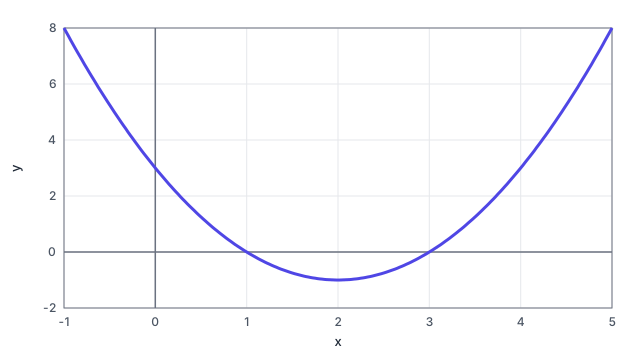
Q17. The figure shows the graph of y = x² − 4x + 3. What are the coordinates of its vertex?
- A. (2, −1)
- B. (1, 0)
- C. (2, 1)
- D. (−2, 1)
Q18. Using the graph of y = x² − 4x + 3, for which value of k does the line y = k meet the curve at exactly one point?
- A. 0
- B. 3
- C. −1
- D. 1
Q19. For which domain is f(x) = (x − 2)² a one-one function?
- A. x ≥ 2
- B. −2 ≤ x ≤ 2
- C. x ≥ 0
- D. x ∈ ℝ
Q20. A circle has centre (3, −2). What is the gradient of the tangent at the point (6, 2)?
- A. 3/4
- B. −4/3
- C. −3/4
- D. 4/3