O Level & A Level Mathematics (Cambridge)
A Level Maths — Mechanics, Set 2
Take the A Level Maths — Mechanics, Set 2: 20 multiple-choice questions (30 minutes) with instant scoring and a full answer review. Covers 20 A Level…
What this test covers
- 20 A Level Mechanics
Sample questions with answers
The first 5 questions of this test, with the correct answer and explanation.
Q1. A car decelerates uniformly from 25 m/s to rest in 5 s. What is its deceleration?
- A. 0.2 m/s²
- B. 125 m/s²
- C. 20 m/s²
- D. 5 m/s² ✓
Answer: D. 5 m/s²
Explanation: a = (0 − 25)/5 = −5 m/s².
Q2. For the same car (25 m/s to rest in 5 s), how far does it travel while braking?
- A. 62.5 m ✓
- B. 25 m
- C. 125 m
- D. 50 m
Answer: A. 62.5 m
Explanation: s = ½(u + v)t = ½ × 25 × 5 = 62.5 m.
Q3. A ball is thrown vertically upwards at 20 m/s. Taking g = 10 m/s², what is its greatest height?
- A. 2 m
- B. 20 m ✓
- C. 10 m
- D. 40 m
Answer: B. 20 m
Explanation: v² = u² − 2gs: 0 = 400 − 20s, so s = 20 m.
Q4. For the same ball (20 m/s upwards, g = 10 m/s²), how long does it take to reach its highest point?
- A. 4 s
- B. 2 s ✓
- C. 20 s
- D. 1 s
Answer: B. 2 s
Explanation: v = u − gt: 0 = 20 − 10t, so t = 2 s.
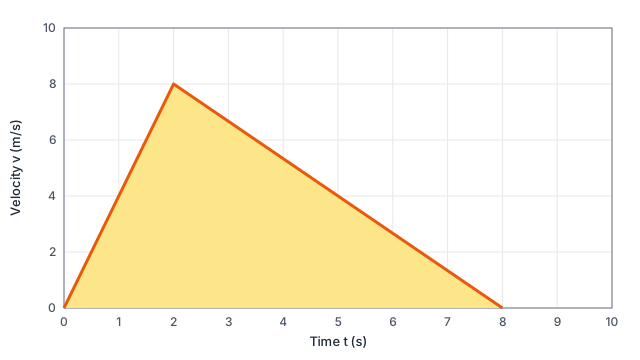
Q5. The figure shows a particle speeding up and then slowing down to rest. What total distance does it travel?
- A. 16 m
- B. 64 m
- C. 32 m ✓
- D. 40 m
Answer: C. 32 m
Explanation: Area of the triangle = ½ × 8 × 8 = 32 m.
The other 15 questions
Take the timed test (free, no sign-up) to see your score and the answer and explanation for every question.
Q6. From the same graph, what is the deceleration between t = 2 s and t = 8 s?
- A. 8 m/s²
- B. 1.33 m/s²
- C. 4 m/s²
- D. 0.75 m/s²
Q7. A 1200 kg car accelerates at 2.5 m/s² against a resistance of 500 N. What is the driving force?
- A. 2500 N
- B. 1700 N
- C. 3500 N
- D. 3000 N
Q8. A 4 kg block on a rough horizontal surface (μ = 0.25) is pulled by a horizontal 20 N force. Taking g = 10 m/s², what is its acceleration?
- A. 3.75 m/s²
- B. 5 m/s²
- C. 2.5 m/s²
- D. 1.25 m/s²
Q9. A particle slides down a smooth slope inclined at θ, where sin θ = 0.6. Taking g = 10 m/s², what is its acceleration?
- A. 4 m/s²
- B. 8 m/s²
- C. 10 m/s²
- D. 6 m/s²
Q10. Forces of 5 N and 12 N act at right angles. What is the magnitude of their resultant?
- A. 17 N
- B. 7 N
- C. 60 N
- D. 13 N
Q11. A 10 kg particle hangs at rest from a vertical string. Taking g = 10 m/s², what is the tension?
- A. 10 N
- B. 100 N
- C. 0 N
- D. 1 N
Q12. A 0.5 kg ball travelling at 10 m/s bounces back at 6 m/s. What is the magnitude of the impulse on it?
- A. 8 N s
- B. 4 N s
- C. 16 N s
- D. 2 N s
Q13. A 3 kg particle moving at 5 m/s hits a stationary 2 kg particle. Afterwards the 3 kg particle moves at 1 m/s in the same direction. What is the speed of the 2 kg particle?
- A. 7.5 m/s
- B. 4 m/s
- C. 3 m/s
- D. 6 m/s
Q14. How much work is done against a friction force of 15 N over 20 m?
- A. 300 J
- B. 150 J
- C. 35 J
- D. 0.75 J
Q15. An object falls 5 m from rest with no air resistance. Taking g = 10 m/s², what is its speed at the bottom?
- A. 5 m/s
- B. 10 m/s
- C. 100 m/s
- D. 50 m/s
Q16. A lorry's engine works at 30 kW, and its maximum speed is 20 m/s. What is the resistance to motion?
- A. 6000 N
- B. 1.5 N
- C. 1500 N
- D. 600 N
Q17. A 1000 kg car's engine works at 20 kW. At 10 m/s the resistance is 800 N. What is the acceleration?
- A. 1.2 m/s²
- B. 2.8 m/s²
- C. 0.8 m/s²
- D. 2 m/s²
Q18. Particles of 4 kg and 6 kg on a smooth horizontal surface are joined by a light string. A 30 N force pulls the 6 kg particle. What is the tension in the string?
- A. 18 N
- B. 30 N
- C. 12 N
- D. 3 N
Q19. A particle has velocity v = 3t² − 2t. What is its acceleration at t = 2?
- A. 12 m/s²
- B. 4 m/s²
- C. 8 m/s²
- D. 10 m/s²
Q20. A particle starts from the origin with velocity v = 4t. What is its displacement at t = 3?
- A. 18 m
- B. 36 m
- C. 12 m
- D. 6 m